In 2025, LinkedIn continues to dominate as the #1 platform for B2B marketing and demand generation. With over 1 billion members worldwide, it’s no longer just a networking hub it’s a content engine driving real business growth. Whether you’re a marketer, founder, or sales professional, your ability to master LinkedIn content marketing directly impacts your brand visibility, thought leadership, and lead generation.
But here’s the challenge: the platform is evolving rapidly. To succeed, you need a future-ready LinkedIn marketing strategy built on algorithm insights, content trends, and proven engagement tactics. Let’s dive deep into what works best in 2025.
Understanding the LinkedIn Algorithm in 2025
The LinkedIn algorithm in 2025 has one goal: deliver authentic, engaging, and valuable content to users. Here’s what you need to know:
– Authenticity First – Posts that feel genuine and personal (not overly polished or salesy) get prioritized.
– Dwell Time Matters – The longer users spend reading, clicking, or interacting with your content, the higher LinkedIn boosts it.
– Engagement Signals – Comments, reposts, and meaningful conversations outweigh vanity likes.
– Relevance & Consistency – Posting regularly (without spamming) keeps you in front of your target audience.
👉 Tip: Encourage thoughtful discussions in your posts. Questions and storytelling outperform plain promotional content.
Building a Winning LinkedIn Content Marketing Strategy
A successful LinkedIn marketing strategy in 2025 requires structure, not guesswork. Follow these steps:
- Define Clear Goals – Brand awareness, lead generation, or thought leadership?
- Know Your Audience – Use LinkedIn Analytics and Sales Navigator for insights.
- Develop Content Pillars – Mix educational, inspirational, and industry-focused topics.
- Create a Posting Cadence – 3–5 posts per week works best for consistency.
- Measure & Optimize – Track engagement rate, CTR, and conversions to refine your approach.
Types of Content That Perform Best on LinkedIn in 2025
LinkedIn has expanded content formats and variety wins. Top-performing formats include:
- Text-Only Posts – Short, storytelling-style updates that spark conversations.
- Carousels – Visual slideshows that simplify complex ideas and boost shareability.
- Videos – Quick insights, behind-the-scenes clips, or expert explainers (native video performs better than external links).
- LinkedIn Newsletters – Nurture subscribers with in-depth thought leadership.
- Polls & Interactive Content – Quick wins for engagement and market insights.
- Thought Leadership Articles – Longer content showcasing your expertise.
Best Practices for Maximizing LinkedIn Engagement
To win on LinkedIn, it’s not just what you post, it’s how you engage with your audience. The right approach turns your content from a one-way broadcast into meaningful conversations.
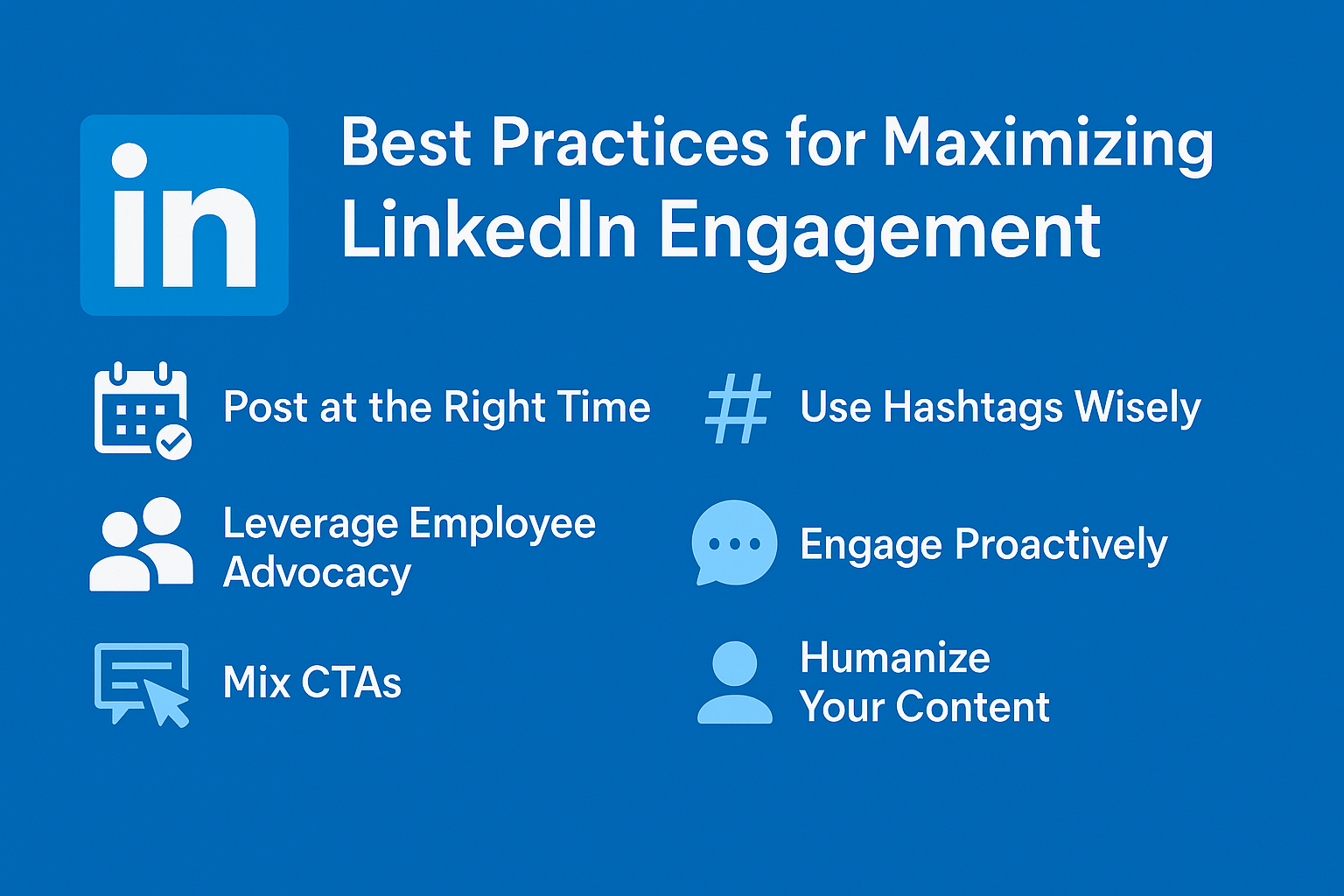
– Post at the Right Time – Early mornings (8–10 AM) on weekdays generally perform best, but test different times to see when your audience is most active.
– Use Hashtags Wisely – Stick to 3–5 highly relevant hashtags. Mix broad industry tags with niche-specific ones to improve discoverability.
– Leverage Employee Advocacy – Your team can amplify reach. Encourage them to share posts with their own insights for a personal touch.
– Engage Proactively – Don’t just post and disappear. Comment thoughtfully on others’ content and reply quickly to your audience to boost visibility.
– Mix CTAs – Balance between soft asks (“What’s your take?”) to drive discussions and direct CTAs (“Download our free guide”) to generate leads.
👉 Pro Tip: LinkedIn rewards consistency and early engagement. Publishing regularly and encouraging immediate interactions can significantly increase reach.
Leveraging LinkedIn for Lead Generation
Content should do more than build awareness it should drive results. Here’s how to use LinkedIn for lead generation:
– Gated Assets – Share ebooks, whitepapers, or reports via LinkedIn lead gen forms.
– InMail Campaigns – Nurture leads with personalized InMail, supported by engaging content.
– Case Studies & Social Proof – Share client success stories to build trust.
– Retargeting – Use LinkedIn Ads to retarget users who engaged with your content.
Optimizing Your LinkedIn Company Page
Your LinkedIn company page is often the first impression prospects see. Make it count:
– SEO-Friendly Descriptions – Add keywords naturally in your “About” section.
– Engaging Banner & Logo – Visually represent your brand identity.
– Consistent Posting – Keep the page active with weekly updates.
– Clear CTA Buttons – Use “Visit Website” or “Sign Up” to drive traffic.
Metrics That Define Success in 2025
Forget vanity metrics. In 2025, success means aligning LinkedIn with business growth:
– Engagement Rate – Shows how meaningful your content is.
– CTR (Click-Through Rate) – Measures traffic driven to your website.
– Conversion Rate – Tracks leads and sign-ups from content.
– Pipeline Influence – How many MQLs/SQLs your LinkedIn strategy drives.
Common Mistakes to Avoid in LinkedIn Marketing Common Mistakes to Avoid in LinkedIn Marketing
Even seasoned marketers slip up. Avoid these pitfalls to keep your LinkedIn strategy strong :
– Overpromotion – Don’t sell in every post; provide value first.
– Ignoring Analytics – Track engagement, CTR, and conversions to improve.
– Generic Copy-Paste Content – Customize posts for LinkedIn’s audience.
– Skipping New Formats – Try carousels, polls, newsletters, and video.
– No Employee Advocacy – Missing out on organic reach from your team.
– Inconsistent Posting – Stick to a steady 3–5 posts per week.
– Weak CTAs – Always guide readers to comment, click, or share.
– No Engagement – Respond to comments and join conversations.
– Chasing Vanity Metrics – Focus on leads and conversions, not just likes.
– Unoptimized Company Page – Keep your page fresh, keyword-rich, and branded.
Future Trends in LinkedIn Content Marketing
The future is exciting for marketers. Watch out for these LinkedIn content marketing trends in 2025 :
– AI-Driven Personalization – Tailored feed experiences powered by AI.
– AR/VR Integration – Virtual networking and immersive brand events.
– Niche Communities – Growth of micro-communities within LinkedIn.
– Micro-Influencers – Smaller creators driving higher engagement and trust.
Conclusion: Crafting a Sustainable LinkedIn Content Strategy
Success on LinkedIn in 2025 is about more than posting it’s about building authentic relationships, driving engagement, and aligning content with business goals. Stay adaptable, experiment with new formats, and let data guide your decisions.
🚀 Ready to elevate your brand on LinkedIn? Start implementing these best practices today and position yourself as a thought leader for tomorrow.
FAQs
1. What is a performance marketing agency?
A performance marketing agency focuses on measurable results—like leads, sales, and ROI—unlike traditional agencies that emphasize brand visibility alone.
2. How do I know if an agency is among the “top”?
Look for case studies, client testimonials, certifications, transparent reporting, and consistent ROI delivery.
3. How soon will I start seeing results?
Typically, initial insights appear within 4–6 weeks. Expect measurable growth in 2–3 months, depending on industry and strategy.
4. What metrics should I expect them to track and report?
Expect ROI/ROAS, CPA, CTR, conversion rate, customer lifetime value (LTV), and pipeline contribution. Transparency is key.
5. Will I have input in the campaign strategy ?
Yes. The best agencies collaborate with you aligning on goals, messaging, and regular strategy workshops.
At Balistro, we specialize in helping businesses grow through effective digital marketing strategies. From Google Ads to Meta Ads, we deliver data-driven campaigns that maximize your ROI and drive real results. If you’re looking to boost your online presence, generate leads, or scale your e-commerce business, our expert team is here to help. Contact us today to learn more about how we can support your advertising needs!
Ready to Grow Your Business?
Book a free 30-minute strategy call with Balistro. We’ll audit your marketing and show you exactly where your biggest growth opportunities are.
Building a LinkedIn Content Strategy That Generates B2B Leads in 2026
LinkedIn has quietly become the highest-converting social platform for B2B brands. With over 1 billion members and a feed algorithm that rewards expertise over entertainment, it’s the one channel where a well-executed content strategy can directly generate qualified leads — without any paid media spend.
The 4 Content Pillars Every B2B LinkedIn Strategy Needs
- Authority content: Deep dives, frameworks, and how-to guides that establish your expertise. This is the content that gets saved and reshared weeks after publishing.
- Social proof content: Client results, case studies, and testimonials presented as stories. Numbers make this credible; narrative makes it memorable.
- Culture content: Behind the scenes of how your team works, decisions you’ve made, lessons learned. This builds trust and humanises your brand to potential buyers.
- Engagement content: Questions, polls, and opinion posts designed to start conversations. These boost your algorithmic reach by generating comments quickly.
LinkedIn Algorithm: What Actually Drives Reach in 2026
LinkedIn’s algorithm has changed significantly. It now prioritises:
- Dwell time — how long people spend reading your post before scrolling
- Comments over likes — meaningful conversation beats passive engagement
- First-hour engagement — the window immediately after posting is critical
- Connection relevance — posts shown to people in your industry get boosted when they engage
Practical implication: publish when your audience is online (typically Tuesday–Thursday, 8–10am or 5–6pm), and reply to every comment within the first hour. This creates an engagement loop that signals the algorithm to keep distributing your post.
Measuring LinkedIn Content Marketing ROI
The biggest mistake B2B brands make on LinkedIn is measuring vanity metrics — follower count and impressions — instead of business metrics. The KPIs that actually matter:
- Profile views from decision-makers (check LinkedIn Analytics → Who viewed your profile)
- Connection requests from target ICP (ideal customer profile)
- Direct message inquiries attributed to specific posts
- Website visits from LinkedIn (track in GA4 via utm_source=linkedin)
LinkedIn Content Marketing Strategy for D2C and B2B Brands in India
India’s LinkedIn user base crossed 130 million in 2025, making it one of the fastest-growing markets on the platform. For D2C and B2B brands targeting Indian decision-makers, a localised LinkedIn content marketing strategy is no longer optional — it’s a competitive advantage. The buying behaviour of Indian professionals differs from Western markets: longer consideration cycles, stronger preference for peer validation, and high trust placed in founder-led storytelling.
Key adjustments for the Indian market:
- Founder-led content converts best. A post from the company founder sharing a real business challenge consistently outperforms polished brand content. Indian audiences respond strongly to authenticity and the “built in India” narrative.
- Regional language hooks. Opening a post with a Hindi or regional language phrase (even a single line) in a primarily English post increases comment rates significantly among Indian professionals.
- Timing for Indian audiences. Peak engagement windows are 8–9am and 7–9pm IST — aligned with morning commutes and post-dinner scrolling habits.
- Client result posts with data. “We helped a D2C brand reduce CAC by 34% in 90 days” style posts generate DMs from similar brands. Specificity builds credibility fast.
If you’re scaling a D2C or B2B brand, pairing LinkedIn content with a strong digital marketing strategy creates a compounding effect: LinkedIn builds trust and inbound interest, while paid channels like Google Ads and Facebook Ads convert that warm audience faster.
How to Repurpose LinkedIn Content Across Channels
One of the highest-leverage habits in content marketing is repurposing. A single well-performing LinkedIn post contains enough signal and structure to fuel multiple other content assets:
- LinkedIn post → Email newsletter. Expand a high-engagement post into a 300-word email to your subscriber list. Use the LinkedIn comments as social proof within the email.
- LinkedIn carousel → Blog post. A 10-slide carousel on “5 reasons your Google Ads aren’t converting” maps directly to a structured blog post with headers and examples.
- LinkedIn article → SEO landing page fodder. Long-form articles that perform well on LinkedIn often contain the depth needed for a full SEO page. Add internal links and publish on your site.
- LinkedIn video → Short-form social cuts. Record a 3-minute talking-head video for LinkedIn, then cut 30-second clips for Instagram Reels and YouTube Shorts.
This repurposing loop also feeds your email marketing pipeline and improves overall content ROI without requiring entirely new content creation every day.
Frequently Asked Questions: LinkedIn Content Marketing Strategy
How often should I post on LinkedIn for best results?
Consistency beats frequency. For most B2B brands and individuals, posting 3–5 times per week produces better compounding reach than posting daily for a month and then going quiet. Quality per post matters more than volume — each post should have a clear insight, a specific audience, and a reason to engage.
What type of LinkedIn content generates the most leads?
Carousel posts with actionable frameworks, client case studies with specific metrics, and “unpopular opinion” posts that challenge conventional thinking tend to generate the most direct message inquiries and profile visits from potential buyers. Long-form written posts that tell a transformation story also perform strongly for lead generation.
Should a company page or personal profile be the focus?
In 2025, personal profiles have significantly higher organic reach than company pages. LinkedIn’s algorithm prioritises person-to-person content. The ideal approach: use the founder’s or senior team’s personal profiles as the primary content channel, while the company page serves as a credibility hub and amplifies top posts. Over time, build both in parallel.
How do I measure if my LinkedIn content marketing strategy is working?
Track profile visits from decision-makers, inbound connection requests from your ICP, direct message volume, and website traffic from LinkedIn in GA4 (utm_source=linkedin). Vanity metrics like impressions and follower count are secondary — the primary signal is whether content is generating real conversations with potential buyers.
Can LinkedIn content marketing work for B2C brands?
Yes, especially for D2C brands targeting business owners, professionals, and urban consumers. LinkedIn works best for D2C products with a professional or aspirational angle — business tools, premium lifestyle products, upskilling services, and health/wellness brands targeting working professionals. Pair LinkedIn content with a well-structured data analytics framework to track attribution properly across channels.
Ready to turn your LinkedIn presence into a consistent source of B2B leads? Book a free strategy call with Balistro’s digital marketing team.