

Content pillars are the foundational topics around which you build clusters of related articles, boosting SEO, authority, and user engagement. This post explains what content pillars are, why they matter, and how to plan, execute, and measure a pillar strategy complete with examples from HubSpot and Moz. You’ll finish with an actionable checklist and FAQs to launch your first pillar page.
What Are Content Pillars?
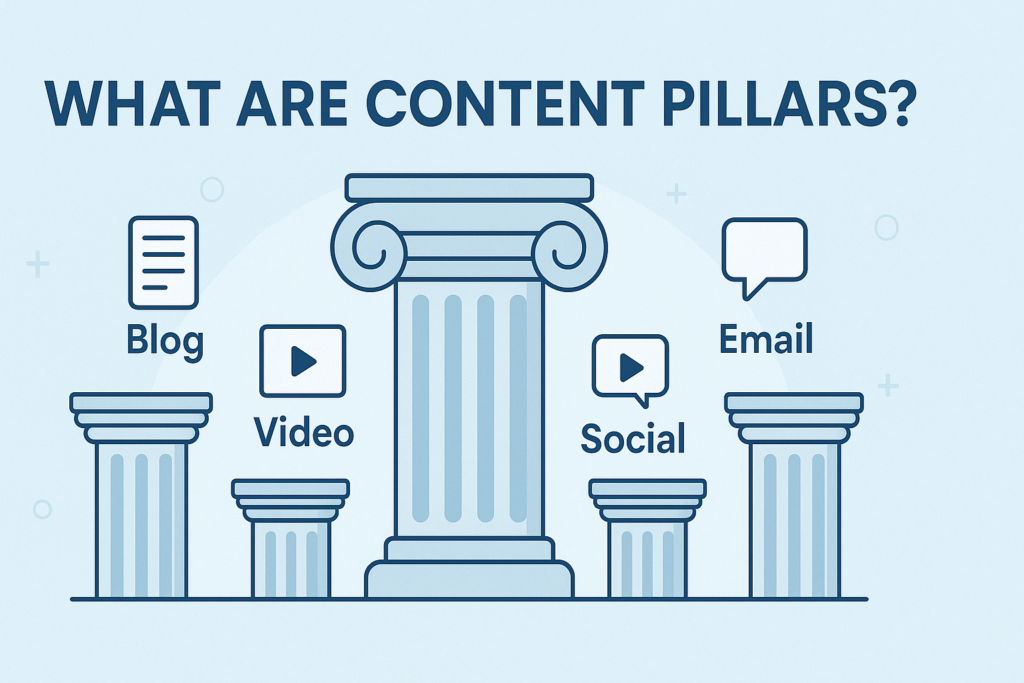
Content pillars (aka “pillar pages”) are in-depth hub pages that cover a core topic comprehensively, with “spoke” pages linking back on subtopics. This hub-and-spoke model signals topical authority to search engines, improving rankings . Pillar pages typically run 2,000+ words, include multimedia, and serve as a central reference for a topic cluster.
SEO Benefit of the Hub-and-Spoke Model
–Authority boost: Internal links from spokes pass link equity to the pillar.
–User experience: Visitors find all key info in one place, reducing bounce.
–Keyword coverage: Clusters let you rank for long-tail variations around the main term.
Why You Need Content Pillars in Your Strategy
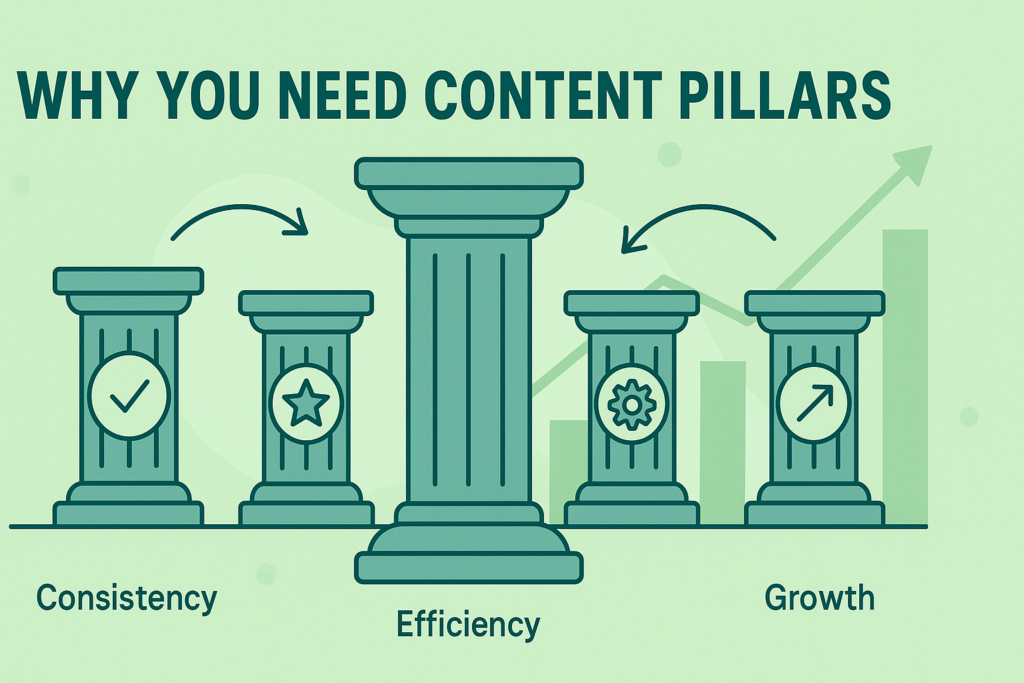
Improve Organic Traffic & Authority
Brands using pillar pages see up to 40% more organic traffic . By concentrating link equity on a single hub, you outrank fragmented blog posts.
Enhance Brand Consistency & UX
A pillar ensures consistent messaging and design. Users navigate related articles via clear menus, boosting time on site.
How to Identify Your Core Content Pillars
1. Align with business goals: Choose topics tied to your offerings (e.g., “content pillars” for an SEO agency).
2. Assess audience needs: Survey customers or analyze support tickets to surface top questions .
3. Validate with keyword research: Look for 400–8,000 monthly searches with medium competitiveness.
Conducting Keyword Research for Pillars
| Tool | Usage | Volume Sweet Spot |
| Google Keyword Planner | Find high-volume head terms | 4,000–8,000/mo |
| SEMrush Keyword Magic | Analyze competitive difficulty & intent | 1,000–5,000/mo |
| Ubersuggest | Discover long-tail variations | 400–2,000/mo |
Use filters for relevancy and prioritize keywords with keyword difficulty under 60.
Mapping Topic Clusters Around Your Pillars
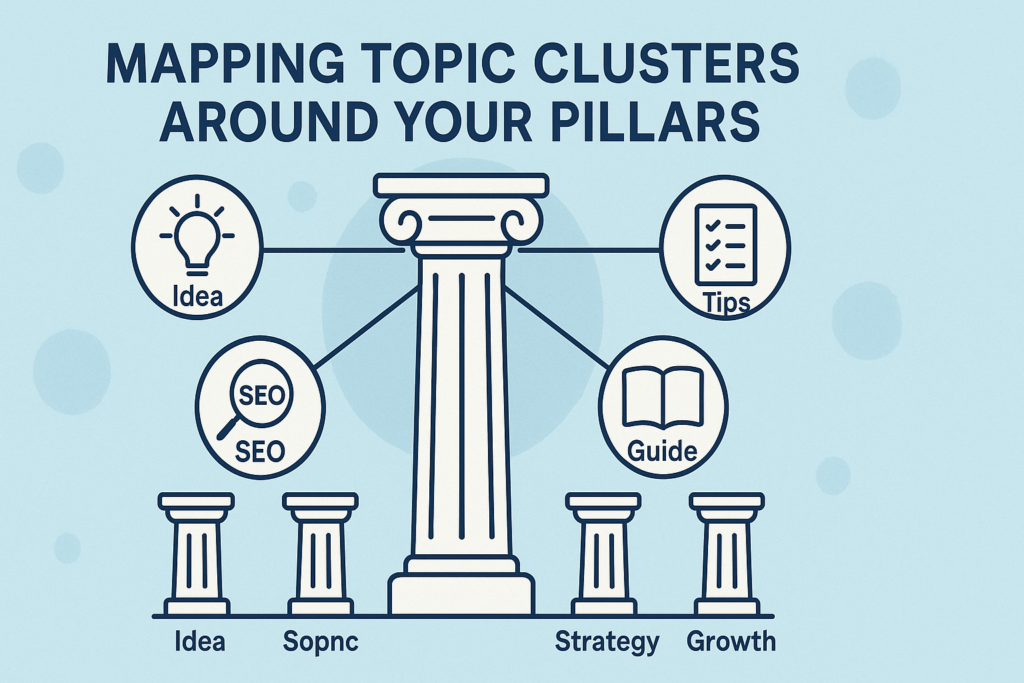
1. Create a cluster map: Draw your pillar at center, spokes for each subtopic.
2. Internal linking: Each spoke must link back to the pillar and to related spokes .
3. Example: For “content pillars,” spokes could be “how to choose pillars,” “pillar page examples,” and “measuring pillar performance.”
Types of Pillar Pages: “What Is,” “How-To,” and “Guide”
| Format | Focus | Mini-Example Title |
| What Is | Definition & overview | What Is a Content Pillar? |
| How-To | Step-by-step instructions | How to Build a Content Pillar Strategy |
| Guide | Comprehensive resource + tools | The Ultimate Guide to Content Pillars in 2025 |
Each format serves distinct user intent: awareness, action, and deep research.
Measuring Pillar Performance (KPIs & Tools)
| KPI | Tool | Why It Matters |
| Organic traffic | Google Analytics | Shows reach of pillar hub |
| Time on page | GA Behavior reports | Indicates engagement depth |
| Backlinks | Ahrefs | Measures authority gained |
| Conversions | Google Analytics | Tracks business outcome |
Review quarterly to spot declines and update content.
Common Mistakes to Avoid with Content Pillars
1. Overly broad topics: Too many spokes dilute relevance.
2. Poor linking structure: Missing reciprocal links weakens SEO .
3. Neglecting updates: Outdated data harms authority; schedule quarterly reviews .
Content Pillars Examples from Top Brands
HubSpot
HubSpot’s “What Is Inbound Marketing?” pillar spans 3,500 words, 20 internal links, and video explainers .
Moz
Moz’s “Beginner’s Guide to SEO” is a 10-chapter guide with quizzes and downloadable assets .
Next Steps: Building Your First Content Pillar Strategy
| Step | Action | Timeline |
| 1 | Audit existing content | Week 1 |
| 2 | Keyword & audience research | Weeks 2–3 |
| 3 | Outline pillar & cluster topics | Week 4 |
| 4 | Write & publish pillar + 3 spokes | Weeks 5–7 |
| 5 | Promote & build backlinks | Weeks 8–10 |
| 6 | Review KPIs & update | Quarterly ongoing |
FAQs
1. What exactly is a content pillar?
A content pillar is an in-depth hub page covering a core topic, linking to related subtopic pages (spokes). See “What Are Content Pillars?” above.
2. How many content pillars should I have?
Aim for 3–5 pillars to focus your authority without spreading too thin social-media best practices recommend this range.
3. What’s the difference between a pillar page and a blog post?
Pillar pages act as comprehensive hubs (conversion-focused), while blog posts (spokes) address specific queries (informational).
4. How often should I update my pillar pages?
Quarterly reviews ensure accuracy and freshness; Clariant Creative suggests at least four updates per year.
5. Which tools are best for mapping topic clusters?
Top tools include SEMrush Keyword Magic, HubSpot Topics Tool, and Ubersuggest for visualizing cluster structure.
At Balistro, we specialize in helping businesses grow through effective digital marketing strategies. From Google Ads to Meta Ads, we deliver data-driven campaigns that maximize your ROI and drive real results. If you’re looking to boost your online presence, generate leads, or scale your e-commerce business, our expert team is here to help. Contact us today to learn more about how we can support your advertising needs!
Ready to Grow Your Business?
Book a free 30-minute strategy call with Balistro. We’ll audit your marketing and show you exactly where your biggest growth opportunities are.
Why Strategic Digital Marketing Is Essential for Business Growth in India
India’s digital advertising market is projected to reach ₹62,000 crore by 2026, growing at 25% CAGR (Source: Dentsu Digital Report). This explosive growth means more businesses are competing for digital attention than ever before. Without a strategic digital marketing approach, brands risk being invisible to their target audience.
The most successful brands in India’s digital landscape don’t rely on a single channel — they build integrated marketing ecosystems. Brands using 3+ digital channels see 287% higher purchase rates than single-channel campaigns (Source: Omnisend). This multi-channel approach, when executed strategically, creates multiple touchpoints throughout the customer journey.
For D2C and B2B brands specifically, digital marketing has become the primary growth driver. With 78% of Indian businesses increasing their digital marketing budgets in 2025, the competitive landscape demands not just presence but excellence across search, social, email, and content channels.
Building an Integrated Digital Marketing Strategy
- Customer Research & Persona Development: Start with deep customer research — analyze your existing customer data, conduct surveys, review search queries, and study competitor audiences. Build detailed buyer personas including demographics, pain points, digital behavior, and preferred content formats.
- Channel Strategy & Prioritization: Not every channel is right for every business. D2C brands should prioritize Meta Ads, Google Shopping, email marketing, and SEO. B2B brands focus on Google Search, LinkedIn, content marketing, and email nurturing. Start with 2-3 core channels and expand based on data.
- Content Strategy & Calendar: Develop a content strategy that supports every stage of the funnel — awareness (blog posts, social content), consideration (case studies, comparison guides), and decision (product pages, testimonials). Create a monthly content calendar with themes aligned to business goals and seasonal opportunities.
- Paid Media Strategy: Structure paid campaigns by funnel stage with appropriate budgets. Allocate 40% to prospecting (awareness), 30% to remarketing (consideration), and 30% to conversion campaigns. Use cross-channel remarketing to nurture prospects across platforms.
- Measurement & Optimization: Implement comprehensive tracking across all channels. Build a unified dashboard that shows the complete customer journey. Use data to continuously optimize — shift budget to top-performing channels, refine targeting, and improve creative based on performance insights.
Digital Marketing Mistakes That Stunt Business Growth
- No clear strategy or goals: Running ads and posting content without a coherent strategy wastes budget and effort. Define specific, measurable goals for each channel — traffic, leads, revenue — and build campaigns that directly support those objectives.
- Channel silos: Running each marketing channel independently creates disconnected customer experiences and misses cross-channel optimization opportunities. Integrate your channels so email supports paid media, content supports SEO, and social supports brand building in a cohesive ecosystem.
- Chasing trends over fundamentals: New platforms and tactics are exciting, but sustainable growth comes from mastering fundamentals — compelling messaging, strong offers, excellent landing pages, and data-driven optimization. Build a strong foundation before experimenting with emerging channels.
- Underinvesting in retention: Most brands overspend on acquisition and underinvest in retention. Retaining existing customers costs 5-7x less than acquiring new ones. Build email automation, loyalty programs, and post-purchase experiences that maximize customer lifetime value.
- Not investing in brand: Performance marketing drives immediate results, but brand building creates long-term competitive advantage. Strong brands enjoy higher conversion rates, lower acquisition costs, and greater pricing power. Allocate at least 20-30% of marketing budget to brand-building activities.
Frequently Asked Questions
How much should a small business spend on digital marketing in India?
Small businesses in India should allocate 7-15% of revenue to digital marketing, with a minimum of ₹25,000-50,000 per month for meaningful impact. Start with the channels most likely to drive immediate revenue — Google Ads for intent-based traffic and social media ads for awareness — then expand as you see returns.
What is the most effective digital marketing channel for B2B?
For B2B companies in India, Google Search Ads and LinkedIn are typically the most effective channels for lead generation. Content marketing and SEO build long-term authority and organic lead flow. Email marketing nurtures leads through longer B2B sales cycles. The optimal mix depends on your industry, target audience, and sales process.
How do I measure digital marketing success?
Measure success against your business objectives: revenue growth, customer acquisition cost (CAC), return on ad spend (ROAS), organic traffic growth, conversion rates, and customer lifetime value (CLV). Avoid vanity metrics like impressions or followers unless they directly correlate with business outcomes. Set up proper attribution to understand which channels drive real results.
Ready to Grow Your Business?
At Balistro Consultancy, we help D2C and B2B brands achieve measurable marketing results through data-driven strategies. Whether you need Google Ads management, Facebook advertising, SEO services, or email marketing, our team of certified specialists is ready to help you grow.
Book a free consultation call to discuss your marketing goals and discover how Balistro can drive real results for your brand.
Building a Sustainable Digital Marketing Growth Engine
Sustainable digital marketing growth requires building systems and processes that compound over time, rather than relying on short-term campaign tactics. The most successful brands treat digital marketing as an integrated ecosystem where each channel amplifies the effectiveness of every other channel.
The concept of compounding returns in digital marketing is most clearly demonstrated through SEO and content marketing. Every piece of quality content published, every backlink earned, and every technical improvement made contributes to an ever-growing foundation of organic visibility. Unlike paid advertising — which stops delivering the moment you stop paying — organic growth compounds over months and years.
Marketing technology integration is often the difference between good and great marketing performance. When your CRM, email platform, ad platforms, analytics tools, and website work together seamlessly, you gain a unified view of the customer journey that enables truly personalized marketing at scale. The investment in proper martech integration pays dividends through improved targeting accuracy, better attribution, and more efficient workflows.
Brand building and performance marketing are not opposing strategies — they are complementary forces that, when balanced correctly, create a powerful growth flywheel. Strong brands enjoy higher click-through rates on ads, better organic rankings, more referral traffic, and higher conversion rates. Allocating 20-30% of digital marketing budget to brand-building activities creates long-term competitive advantages that protect against market fluctuations.
Customer retention and lifetime value optimization represent the most underleveraged growth opportunity for most digital businesses. Acquiring a new customer costs 5-7x more than retaining an existing one, yet most brands spend the vast majority of their marketing budget on acquisition. Building robust retention marketing programs — including email automation, loyalty programs, and customer success initiatives — dramatically improves overall marketing ROI.