
In today’s competitive digital landscape, choosing the right Performance Marketing Agency for ROI can determine whether your business grows profitably or wastes budget on underperforming campaigns. Companies no longer want vanity metrics — they want measurable revenue, lower acquisition costs, and scalable returns. A strategic Performance Marketing Agency for ROI focuses on data-driven decisions, continuous optimization, and conversion-focused campaigns to ensure every marketing dollar delivers maximum return on investment. By partnering with an experienced Performance Marketing Agency for ROI, businesses can build predictable growth systems that drive consistent leads, sales, and long-term profitability.
What Is a Performance Marketing Agency?
A performance marketing agency focuses on results — not just reach or impressions. Unlike traditional marketing firms, these agencies are accountable for specific outcomes such as:
- Lead generation
- Sales conversions
- App installs
- Revenue growth
- Customer acquisition cost (CAC) reduction
- Return on Ad Spend (ROAS)
The core idea is simple: You pay for performance, not promises.
Why Businesses Need the Best Performance Marketing Agency
Digital advertising costs are rising every year. Platforms like Google, Meta, and Amazon have become more competitive than ever. Without a data-driven strategy, brands often:
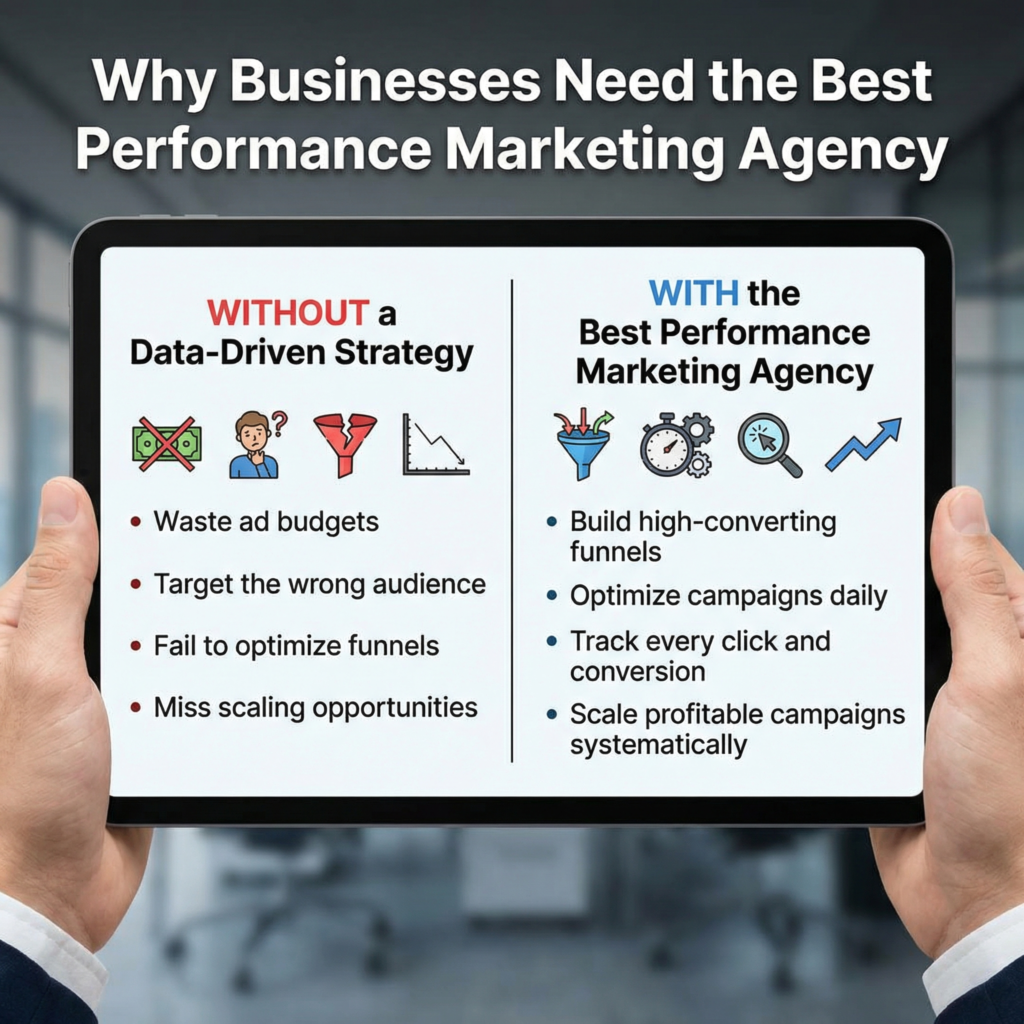
- Waste ad budgets
- Target the wrong audience
- Fail to optimize funnels
- Miss scaling opportunities
The best performance marketing agency helps you:
- Build high-converting funnels
- Optimize campaigns daily
- Track every click and conversion
- Scale profitable campaigns systematically
Key Services Offered by a Top Performance Marketing Agency
If you’re searching for the best performance marketing agency, make sure they offer a full-funnel approach:
1. Paid Media Advertising
- Google Ads (Search, Display, YouTube)
- Meta Ads (Facebook & Instagram)
- LinkedIn Ads
- Programmatic Advertising
2. Conversion Rate Optimization (CRO)
- Landing page testing
- A/B testing
- Funnel optimization
- Heatmap analysis
3. Data Analytics & Tracking
- Pixel implementation
- Server-side tracking
- Google Analytics setup
- Attribution modeling
4. Performance Creative Strategy
- Scroll-stopping ad creatives
- Video ad production
- Conversion-focused copywriting
How to Identify the Best Performance Marketing Agency
Not every agency delivers what they promise. Here’s how to separate the best from the rest:
1. Proven Case Studies
Ask for detailed breakdowns of:
- ROAS improvements
- CAC reductions
- Revenue growth
2. Transparent Reporting
The best performance marketing agency provides:
- Weekly or bi-weekly reports
- Clear KPIs
- Live dashboards
3. Industry Experience
Look for agencies that understand your niche:
- E-commerce
- SaaS
- D2C brands
- Real estate
- Healthcare
4. Strategic Approach, Not Just Execution
A top agency doesn’t just run ads. They:
- Research competitors
- Identify market gaps
- Develop positioning strategies
- Build long-term growth plans
Common Mistakes Businesses Make When Hiring an Agency
Avoid these costly errors:
- Choosing based only on low pricing
- Ignoring tracking setup
- Not defining KPIs clearly
- Hiring agencies with no niche expertise
Remember: The cheapest option is rarely the best performance marketing agency.
Benefits of Working With a Results-Driven Agency
Faster Scaling
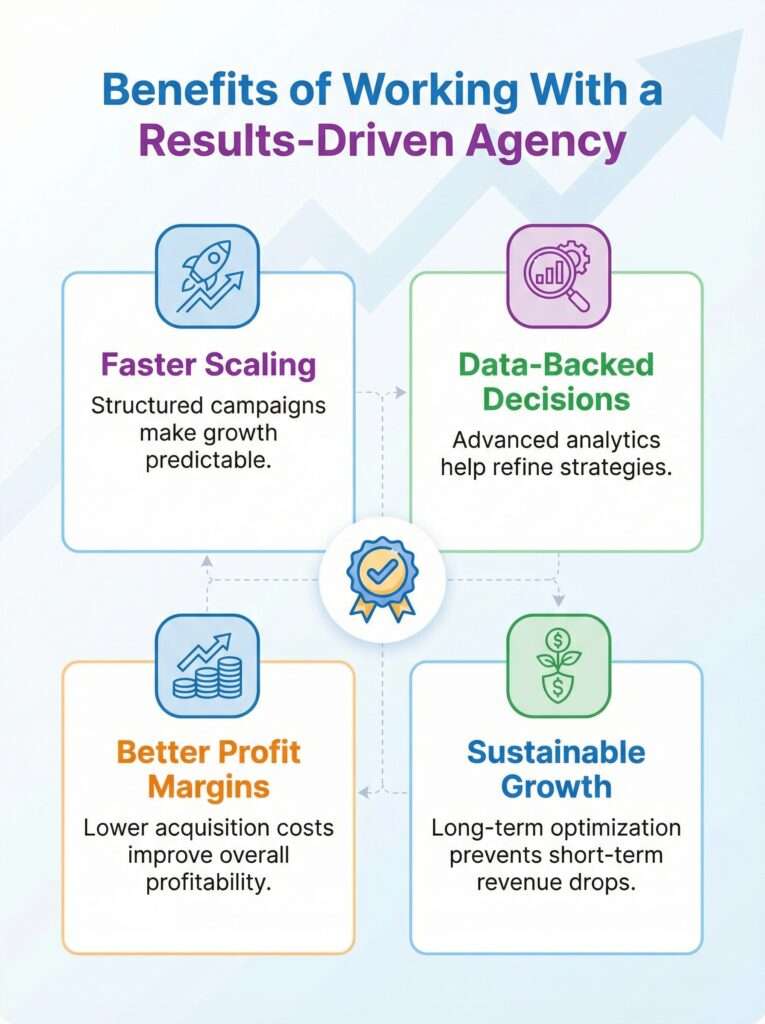
Structured campaigns make growth predictable.
Data-Backed Decisions
Advanced analytics help refine strategies.
Better Profit Margins
Lower acquisition costs improve overall profitability.
Sustainable Growth
Long-term optimization prevents short-term revenue drops.
Trends Shaping Performance Marketing
To stay competitive, the best performance marketing agency adapts to:
- AI-powered campaign optimization
- First-party data strategies
- Server-side tracking
- Creative testing at scale
- Privacy-first marketing frameworks
Frequently Asked Questions (FAQs)
1. What is a performance marketing agency?
A performance marketing agency is a results-driven digital marketing firm that focuses on measurable outcomes such as leads, sales, and revenue rather than just impressions or brand awareness.
2. How does a performance marketing agency generate results?
A performance marketing agency generates results by running paid campaigns on platforms like Google and Meta, tracking user behavior, optimizing ads continuously, and improving landing pages to increase conversions and ROAS.
3. How do I choose the best performance marketing agency?
To choose the best performance marketing agency, look for proven case studies, transparent reporting, industry experience, strong tracking capabilities, and a strategic growth approach.
4. How much does a performance marketing agency cost?
Costs vary depending on ad spend, industry, and services required. Agencies typically charge a monthly retainer, a percentage of ad spend, or follow a performance-based pricing model.
5. How long does it take to see results?
Most businesses see initial performance data within 30–60 days. However, meaningful scaling and optimization usually take 2–3 months for consistent ROI improvements.
6. Is performance marketing suitable for small businesses?
Yes. Performance marketing is ideal for small and mid-sized businesses because it allows controlled spending, targeted reach, measurable ROI, and scalable growth.
Ready to Scale With the Right Strategy?
Choosing the best performance marketing agency is about partnering with a team that understands data, strategy, and sustainable growth.
At Balistro, we focus on measurable outcomes, transparent processes, and scalable marketing systems that drive real business results.
If you’re ready to move beyond guesswork and build predictable revenue growth, it’s time to work with a performance-driven team.
At Balistro, we specialize in helping businesses grow through effective digital marketing strategies. From Google Ads to Meta Ads, we deliver data-driven campaigns that maximize your ROI and drive real results. If you’re looking to boost your online presence, generate leads, or scale your e-commerce business, our expert team is here to help. Contact us today to learn more about how we can support your advertising needs!
Ready to Grow Your Business?
Book a free 30-minute strategy call with Balistro. We’ll audit your marketing and show you exactly where your biggest growth opportunities are.
Why Performance Marketing Is the Growth Engine for Modern Brands
Performance marketing has fundamentally changed how brands approach advertising — shifting from paying for impressions to paying for measurable outcomes like clicks, leads, and sales. This accountability makes every rupee of marketing spend trackable and optimizable, which is why performance-based digital marketing now accounts for 65% of total digital ad spend in India (Source: IAMAI).
For D2C brands in India’s rapidly growing e-commerce market, performance marketing is the primary customer acquisition engine. The ability to test multiple channels — Google Ads, Meta Ads, programmatic, affiliate marketing — and allocate budget to the highest-performing channels in real-time is a competitive advantage that traditional advertising simply cannot match.
The integration of AI and machine learning into performance marketing platforms has accelerated optimization cycles. Automated bidding, dynamic creative optimization, and predictive audience modeling allow brands to achieve better results faster, with algorithms processing thousands of data points to find the most efficient path to conversion.
Building a Performance Marketing Framework That Scales
- Define Clear KPIs & Attribution: Establish your primary KPIs — ROAS for e-commerce, CPL for B2B, CAC for subscription businesses. Set up multi-touch attribution modeling to understand the true contribution of each channel. Avoid last-click attribution which overvalues bottom-funnel channels.
- Channel Mix Strategy: Start with 2-3 channels and expand based on performance data. For most Indian D2C brands, Google Search + Meta Ads is the optimal starting combination. Add Google Shopping, YouTube, and programmatic as you scale. B2B brands should prioritize Google Search + LinkedIn Ads.
- Creative Testing Framework: Develop a systematic creative testing process. Test hooks (first 3 seconds of video, headline of static ads), value propositions, social proof elements, and CTAs. Run 3-5 creative variations per ad set and replace underperformers weekly.
- Budget Allocation & Scaling: Use a 70/20/10 framework — 70% of budget on proven campaigns, 20% on promising tests, 10% on experimental channels. Scale winning campaigns by increasing budget 20-30% every 3-5 days while maintaining ROAS targets.
- Measurement & Optimization Cadence: Review campaign performance daily (budget pacing, anomalies), optimize weekly (bid adjustments, creative swaps, audience refinements), and conduct strategic reviews monthly (channel allocation, funnel analysis, competitive landscape).
Performance Marketing Mistakes That Waste Your Ad Budget
- Optimizing for vanity metrics: Impressions, clicks, and even CTR are vanity metrics if they don’t translate to revenue. Always optimize campaigns for conversion events that align with business outcomes — purchases, qualified leads, or revenue.
- Not investing in landing page optimization: Sending paid traffic to generic homepages or poorly designed landing pages wastes acquisition costs. Create dedicated landing pages for each campaign with clear value propositions, social proof, and frictionless conversion paths.
- Scaling too fast: Dramatically increasing budgets overnight disrupts campaign learning and often tanks performance. Scale gradually — 20-30% budget increases every few days — and monitor performance metrics closely during scaling periods.
- Ignoring the full funnel: Brands that only run bottom-funnel conversion campaigns eventually exhaust their addressable audience. Build awareness and consideration campaigns to feed the top of funnel and create sustainable acquisition growth.
- Poor tracking and attribution: Without accurate conversion tracking across all touchpoints, you can’t make informed optimization decisions. Implement server-side tracking, cross-device attribution, and proper UTM tagging before scaling ad spend.
Frequently Asked Questions
What is a good ROAS for performance marketing?
A good ROAS varies by industry and business model. E-commerce D2C brands typically target 3-5x ROAS, while high-margin businesses can be profitable at 2x. B2B companies often measure success through cost-per-lead rather than ROAS. The key is ensuring your ROAS exceeds your break-even point accounting for product costs, overhead, and customer lifetime value.
How is performance marketing different from digital marketing?
Performance marketing is a subset of digital marketing specifically focused on measurable, results-driven campaigns where you pay for specific outcomes. Digital marketing is broader and includes brand building, content marketing, SEO, and other activities that may not have direct, immediate ROI attribution. Performance marketing prioritizes accountability and data-driven optimization above all else.
How much should I budget for performance marketing?
For D2C brands in India, a starting budget of ₹50,000-₹1,50,000 per month across Google and Meta Ads provides enough data for optimization. B2B brands can start at ₹30,000-₹75,000 per month. Scale budget based on profitability — if campaigns are generating positive ROAS, increase spend systematically to capture more market share.
Ready to Grow Your Business?
At Balistro Consultancy, we help D2C and B2B brands achieve measurable marketing results through data-driven strategies. Whether you need Google Ads management, Facebook advertising, SEO services, or email marketing, our team of certified specialists is ready to help you grow.
Book a free consultation call to discuss your marketing goals and discover how Balistro can drive real results for your brand.
Scaling Performance Marketing: Advanced Strategies for Growth
Scaling performance marketing campaigns profitably requires a fundamentally different approach than launching them. The strategies that work at ₹50,000 monthly spend often break at ₹5,00,000 — and understanding these scaling dynamics is essential for sustainable growth.
Budget scaling should follow a systematic approach: increase campaign budgets by no more than 20-30% every 3-5 days to maintain algorithmic stability. Vertical scaling (increasing budget within existing campaigns) works best up to a point; beyond that, horizontal scaling (launching new campaigns targeting different audiences or creatives) becomes necessary.
Cross-channel attribution is critical for optimizing performance marketing at scale. Multi-touch attribution models reveal the true contribution of each touchpoint in the customer journey, preventing overinvestment in last-click channels and underinvestment in awareness-driving channels. Data-driven attribution models, now available natively in GA4, provide the most accurate picture of channel performance.
Creative fatigue is the most common reason performance marketing campaigns plateau. At higher spend levels, audiences see your ads more frequently, leading to declining CTR and rising CPA. Combating creative fatigue requires a systematic creative production pipeline — testing new hooks, formats, and messaging angles weekly, while scaling proven creative frameworks.
First-party data strategies have become essential for performance marketing success. Building robust customer data platforms, implementing server-side tracking, and leveraging customer match audiences enables more accurate targeting and measurement in an increasingly privacy-conscious digital environment. Brands that invest in first-party data infrastructure consistently outperform competitors relying solely on platform-native audiences.